

Types of Self Control Wheelchairs
Many people with disabilities utilize self-controlled wheelchairs to get around. These chairs are perfect for everyday mobility and they are able to climb hills and other obstacles. They also have a large rear flat shock absorbent nylon tires.
The translation velocity of the wheelchair was calculated using a local potential field approach. Each feature vector was fed to a Gaussian encoder, which outputs a discrete probabilistic spread. The evidence that was accumulated was used to drive visual feedback, and an instruction was issued after the threshold was attained.
Wheelchairs with hand rims
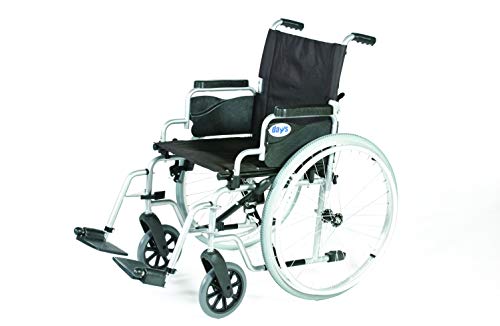
The type of wheel a wheelchair is using can affect its ability to maneuver and navigate different terrains. Wheels with hand-rims are able to reduce strain on the wrist and improve the comfort of the user. Wheel rims for wheelchairs may be made of aluminum, steel, or plastic and are available in various sizes. They can be coated with vinyl or rubber for better grip. Some are ergonomically designed, with features such as an elongated shape that is suited to the grip of the user's closed and wide surfaces to provide full-hand contact. This allows them distribute pressure more evenly and prevents fingertip pressing.
A recent study found that flexible hand rims decrease impact forces as well as the flexors of the wrist and fingers during wheelchair propulsion. They also provide a larger gripping surface than standard tubular rims permitting users to use less force while still retaining the stability and control of the push rim. These rims are sold from a variety of online retailers and DME suppliers.
The results of the study showed that 90% of respondents who had used the rims were satisfied with them. It is important to note that this was an email survey of people who purchased hand rims at Three Rivers Holdings, and not all wheelchair users suffering from SCI. The survey did not examine actual changes in pain or symptoms or symptoms, but rather whether individuals perceived that they had experienced a change.
Four different models are available The light, medium and big. The light is a round rim with small diameter, while the oval-shaped large and medium are also available. The rims that are prime have a larger diameter and a more ergonomically designed gripping area. All of these rims are installed on the front of the wheelchair and are purchased in a variety of shades, from naturalthe light tan color -to flashy blue red, green or jet black. self propelled wheelchair with attendant brakes are quick-release and are able to be removed easily for cleaning or maintenance. The rims have a protective rubber or vinyl coating to prevent the hands from sliding and causing discomfort.
Wheelchairs with tongue drive
Researchers at Georgia Tech have developed a new system that lets users maneuver a wheelchair and control other digital devices by moving their tongues. It is comprised of a tiny tongue stud that has an electronic strip that transmits movements signals from the headset to the mobile phone. The smartphone converts the signals to commands that can be used to control a device such as a wheelchair. The prototype was tested with disabled people and spinal cord injury patients in clinical trials.
To evaluate the performance, a group of healthy people completed tasks that assessed input accuracy and speed. They completed tasks based on Fitts law, which included the use of a mouse and keyboard and maze navigation using both the TDS and the normal joystick. The prototype had a red emergency override button and a person was with the participants to press it if necessary. The TDS worked just as well as the traditional joystick.
Another test The TDS was compared TDS to what's called the sip-and-puff system. It allows those with tetraplegia to control their electric wheelchairs by blowing air into straws. The TDS was able to complete tasks three times faster and with better accuracy than the sip-and-puff system. The TDS is able to drive wheelchairs more precisely than a person with Tetraplegia, who controls their chair with the joystick.
The TDS was able to determine tongue position with an accuracy of less than one millimeter. It also included cameras that could record the eye movements of a person to detect and interpret their movements. It also included software safety features that checked for valid user inputs 20 times per second. Interface modules would automatically stop the wheelchair if they did not receive an appropriate direction control signal from the user within 100 milliseconds.
The next step for the team is testing the TDS with people with severe disabilities. They're collaborating with the Shepherd Center located in Atlanta, a hospital for catastrophic care, and the Christopher and Dana Reeve Foundation to conduct these trials. They plan to improve the system's ability to adapt to lighting conditions in the ambient and add additional camera systems, and allow repositioning for different seating positions.
Wheelchairs with a joystick
A power wheelchair that has a joystick allows users to control their mobility device without relying on their arms. It can be placed in the middle of the drive unit, or on either side. It also comes with a display to show information to the user. Some screens are large and backlit to be more noticeable. Some screens are smaller and others may contain images or symbols that could aid the user. The joystick can also be adjusted for different hand sizes, grips and the distance between the buttons.
As technology for power wheelchairs has advanced in recent years, doctors have been able to develop and modify different driver controls that allow clients to maximize their functional capacity. These innovations also allow them to do this in a manner that is comfortable for the end user.
For instance, a typical joystick is a proportional input device which uses the amount of deflection that is applied to its gimble to provide an output that increases when you push it. This is similar to how video game controllers or accelerator pedals in cars work. This system requires excellent motor skills, proprioception, and finger strength in order to be used effectively.
Another type of control is the tongue drive system, which uses the position of the tongue to determine where to steer. A magnetic tongue stud sends this information to a headset which executes up to six commands. It can be used by those with tetraplegia or quadriplegia.
Certain alternative controls are simpler to use than the standard joystick. This is particularly beneficial for users with limited strength or finger movements. Others can even be operated by a single finger, making them ideal for people who cannot use their hands at all or have limited movement in them.
Certain control systems also have multiple profiles, which can be modified to meet the requirements of each customer. This is essential for novice users who might require adjustments to their settings periodically when they feel tired or have a flare-up of a disease. This is helpful for experienced users who wish to change the settings set for a particular area or activity.
Wheelchairs with steering wheels
Self-propelled wheelchairs are designed for individuals who need to move around on flat surfaces and up small hills. They come with large rear wheels for the user to hold onto as they propel themselves. They also have hand rims that allow the user to make use of their upper body strength and mobility to steer the wheelchair in a forward or reverse direction. Self-propelled wheelchairs are available with a variety of accessories, including seatbelts, dropdown armrests and swing away leg rests. Some models can also be converted into Attendant Controlled Wheelchairs to assist caregivers and family members drive and operate the wheelchair for users that require additional assistance.
To determine kinematic parameters the wheelchairs of participants were fitted with three sensors that monitored movement throughout an entire week. The gyroscopic sensors on the wheels and attached to the frame were used to measure wheeled distances and directions. To distinguish between straight forward movements and turns, the time intervals where the velocities of the left and right wheels differed by less than 0.05 milliseconds were deemed to be straight. Turns were further studied in the remaining segments and the angles and radii of turning were calculated based on the reconstructed wheeled route.
A total of 14 participants took part in this study. They were tested for navigation accuracy and command latency. Using an ecological experimental field, they were asked to steer the wheelchair around four different waypoints. During the navigation trials, sensors monitored the movement of the wheelchair along the entire course. Each trial was repeated at least two times. After each trial, participants were asked to select a direction for the wheelchair to move within.
The results showed that the majority of participants were competent in completing the navigation tasks, although they didn't always follow the correct directions. On average 47% of turns were completed correctly. The other 23% were either stopped immediately after the turn or wheeled into a subsequent turning, or replaced with another straight movement. These results are similar to those of previous studies.